
Helping Our Kids Maintain a Healthy Weight, Part 3

Welcome to my final blog investigating the three behaviors that research shows contribute to childhood obesity. So far we’ve discussed ways to decrease the frequency of eating out and reduce sugar-sweetened beverages. From the above picture, can you guess what the final behavior researchers identified as contributing to childhood obesity? If you guessed portion size, you’re right! If not, you’re in good company as many Americans no longer know what a healthy portion size looks like.
Behavior #3: Provide kids with age-appropriate portions.
What does the research show?
Doubling an age-appropriate portion of an entrée caused children to consume 25% more of the entrée resulting in a 15% increase in the total number of calories consumed. In other words, kids (and adults) eat more when served larger portions.
What can you do as a parent, grandparent or childcare provider?
Serve Your Kids Age-Appropriate Portions
A young child does not need to eat as much as an adult. This is so easy to forget. When you are serving food, keep this simple suggestion in mind: For children 1-5 years old, give about 1 tablespoon of each food for each year of your child’s age. For example, if you’re having mixed vegetables and macaroni and cheese for dinner, you’d serve a 3 year old child 3 tablespoons of the vegetables and 3 tablespoons of macaroni and cheese.
Allow Your Children to Serve Themselves
Another technique practiced in Head Start is to allow your child to serve himself/herself. Research found children consumed 25% less of an entrée when they were allowed to serve themselves as opposed to being served a large portion by an adult.
Respect Your Child When He/She Is Full
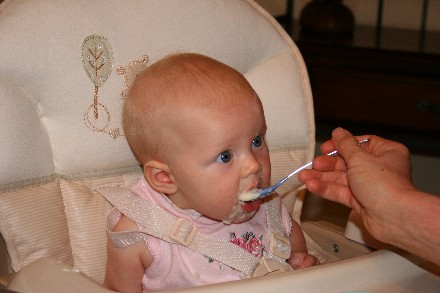
Although my 6 month old daughter can’t talk, she is able to let me know when she’s full. At the start of her rice cereal feeding, she’s excited and amazed at the wonderful substance on the spoon. She opens her mouth like a bird eager for the next spoonful. Sometimes she eats all of the rice cereal in the bowl and other times, she only eats a few spoonfuls with no desire to eat any more. She starts finding the floor fascinating and has lost all interest in the rice cereal. I offer her the spoon again and she jerks her head to the side. It’s hard for me to throw away the leftover cereal made with breast milk, but my daughter knows when she is full and I respect her feelings.
Help your child maintain their innate ability to identify when they are full by allowing them to stop eating when they are full even if there is food still on their plate.
 |
Role Model Healthy Portions
Our children are growing up in a world where 20 oz. bottles of soda and multi-serving snack packages are the norm. Giant cookies seem to be more common than the traditional cookies these days. With all the super-sized portions kids see at restaurants, fast food places, gas stations, and convenience stores, it’s important to show what healthy portions are in your home. I repeat this role modeling advice over and over because the most powerful way you can influence the eating behavior of your children is for you to do the behavior you want them to do.
Curious about how portions have changed over the past 20 years? Check out the following sites:
http://hp2010.nhlbihin.net/portion/portion.cgi?action=question&number=1
http://hp2010.nhlbihin.net/portion/portion2.cgi?action=question&number=1


I have heard that your stomach is about the size of your fist. If this is true, would the portions you suggested be too much?